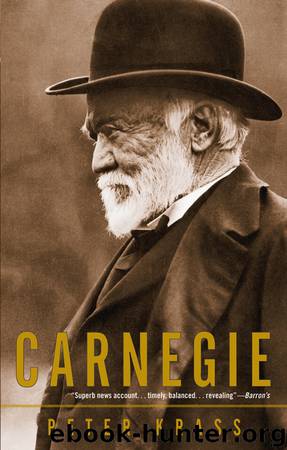
Carnegie by Peter Krass
Author:Peter Krass
Language: eng
Format: epub
Publisher: John Wiley & Sons, Ltd.
Published: 2011-09-14T04:00:00+00:00
One week before the Homestead contract expired, Carnegie departed Coworth Park for Aberdeen, Scotland, where he was to dedicate a library and receive the city’s Freedom, the festivities to be held July 5 and 6.14 Then it would be on to Sir Robert Menzies’ Rannoch Lodge, a picturesque country home on Loch Rannoch in the Highlands, where the Carnegies were to spend the summer while Cluny was being refurbished. That same day Frick met with the Amalgamated’s national president, William Weihe, and a committee of some twenty-five Homestead men led by Hugh O’Donnell. Frick had promised and Carnegie expected that the two sides would no longer confer, but again demonstrating uncertainty, Frick had decided to meet with the enemy. For his part, Frick conceded $1 in per ton wages for billets, offering $23 as a minimum versus $22, but the Amalgamated wouldn’t accept anything less than $24, leaving Frick to advise Carnegie, “We are now preparing for a struggle.”15 Those preparations included Frick hiring a force of three hundred Pinkertons—considered capital’s assassins—to protect the company’s property.16 He instructed the Pinkertons to be prepared, equipped, and assembled on July 5 in Pittsburgh, from where they would boat to the Homestead works.
The union also prepared for a fight and created an Advisory Committee of forty men to direct their battle. The committee set up headquarters in a three-story brick building in Homestead proper, a conspicuous American flag hanging over the dirt street, and two men assumed prominent roles: Hugh O’Donnell, who was elected chairman of the committee, and Homestead mayor John McLuckie. A skilled worker making $144 per month, O’Donnell had seen his share of death in the mill and was ready to make a stand against the greedy capitalists. He had short, cropped hair combed straight back and a walrus mustache, the style of the day; he was a thin, hollow-cheeked, plain-looking fellow, except for his large, round eyes, which were all the more intense as they debated the situation. McLuckie, also a skilled worker, was more hot-blooded than O’Donnell, although one wouldn’t know it by looking at him. He had slicked dark hair, parted just left of center, a soft face with a curtailed handlebar mustache, and oval glasses that gave him a studious air.
After the Advisory Committee was created, the union men hung Frick and Potter in effigy, amid much jeering as a mob psychology began to take hold. The company retaliated by shutting down the works on June 28, two days before the contract expired. In light of Frick’s blockade fence, and the hiring of Pinkertons, the union men realized it was 1889 all over again— war—inducing O’Donnell and McLuckie to issue a brazen declaration: “The committee has, after mature deliberation, decided to organize their forces on a truly military basis.” The document all but guaranteed bloodshed. The four thousand men were divided into three divisions, or watches, to guard against strikebreakers. They posted sentries at all mill entrances, set up a spy network extending to Pittsburgh, and chartered a steamboat to patrol the Monongahela.
Download
This site does not store any files on its server. We only index and link to content provided by other sites. Please contact the content providers to delete copyright contents if any and email us, we'll remove relevant links or contents immediately.
Hit Refresh by Satya Nadella(9132)
When Breath Becomes Air by Paul Kalanithi(8444)
The Girl Without a Voice by Casey Watson(7888)
A Court of Wings and Ruin by Sarah J. Maas(7845)
Do No Harm Stories of Life, Death and Brain Surgery by Henry Marsh(6941)
Shoe Dog by Phil Knight(5267)
The Rules Do Not Apply by Ariel Levy(4969)
A Higher Loyalty: Truth, Lies, and Leadership by James Comey(4962)
Hunger by Roxane Gay(4927)
Tuesdays with Morrie by Mitch Albom(4784)
Everything Happens for a Reason by Kate Bowler(4743)
The Immortal Life of Henrietta Lacks by Rebecca Skloot(4587)
Millionaire: The Philanderer, Gambler, and Duelist Who Invented Modern Finance by Janet Gleeson(4478)
How to Change Your Mind by Michael Pollan(4356)
All Creatures Great and Small by James Herriot(4321)
The Money Culture by Michael Lewis(4207)
Man and His Symbols by Carl Gustav Jung(4135)
Elon Musk by Ashlee Vance(4127)
Tokyo Vice: An American Reporter on the Police Beat in Japan by Jake Adelstein(3996)
